Why Do Blood Test Results Change? Understanding Your Biomarker Trends
Your blood tests changed. But what changed in your life?
Your blood test hasn't changed in isolation.
Your life hasn't stood still. So why would your biomarkers?
6 Nov 2026

Perhaps you’ve been sleeping less, experiencing more stress, training harder or recovering from an illness. Maybe you’ve started a new medication, changed your diet or had your blood taken at a different stage of your menstrual cycle.
These changes can influence what’s happening inside your body, sometimes in ways that are reflected in your blood test results.
But not every change in a biomarker indicates a health problem. Equally, a result falling within a laboratory’s reference range doesn’t always tell you how it compares with your previous measurements.
Understanding your blood test results means looking beyond individual numbers and considering the wider context in which they were measured.
So, what actually causes blood test results to change, and when should those changes matter?
Quick Facts
- Blood test results can fluctuate naturally due to biological variation, even when your health remains stable.
- Sleep, stress, exercise, illness, hydration and medications can influence certain biomarkers.
- Hormone levels can change throughout the day and, for people who menstruate, across the menstrual cycle.
- Laboratory reference ranges provide important clinical guidance, but previous results can sometimes add useful individual context.
- Comparing blood tests over time may help identify patterns, although not every fluctuation is clinically significant.
- Changes should be interpreted alongside symptoms, medical history, medications and the conditions under which testing occurred.
Why Do Blood Test Results Change?
Blood tests measure the concentration or activity of specific substances in your blood at the time your sample is collected.
These substances, known as biomarkers, can provide information about different aspects of your health, including hormonal function, metabolism, inflammation, nutritional status and organ function.
However, many biomarkers are not fixed at one constant level.
Your body is continually responding to its internal and external environment.
Hormones are released and regulated. Nutrients are absorbed and used. Muscles adapt to physical activity. Your immune system responds to infections and other challenges.
As these processes change, certain blood measurements may change alongside them.
In laboratory medicine, there are three important considerations when comparing results:
- Biological variation: The natural fluctuations that occur within an individual, even when their health is relatively stable.
- Analytical variation: Small differences that can occur during laboratory measurement, including the degree of imprecision associated with an assay.
Changes in health or circumstances: Differences associated with illness, medication, lifestyle, physiological changes or underlying medical conditions.
This distinction is important because two results being numerically different does not automatically mean that a clinically meaningful change has occurred.
The size of the difference, the biomarker involved, the laboratory method and your individual circumstances all matter.
1. Stress and Sleep: Can They Affect Your Blood Test Results?
A stressful few months.
Interrupted sleep.
Long working hours.
Changes in your daily routine.
Stress and sleep influence several physiological systems, including hormonal regulation and glucose metabolism.
Stress and Hormonal Regulation
When you experience stress, your body activates systems involved in responding to perceived challenges.
One of these is the hypothalamic-pituitary-adrenal (HPA) axis, which helps regulate cortisol secretion.
Cortisol plays an important role in energy metabolism, blood glucose regulation and the body’s response to stress.
However, cortisol is not released at a constant rate throughout the day.
It follows a circadian rhythm, with concentrations generally higher around the morning waking period and lower later in the evening.
Sleep timing, shift work, acute stress and certain medical conditions can influence this pattern.
This means that two cortisol measurements taken at different times or under different circumstances may not be directly comparable.
A change in cortisol does not automatically indicate a hormonal disorder. Timing, symptoms and clinical context are essential.
Sleep and Glucose Metabolism
Sleep also has an important relationship with metabolic health.
Controlled research has demonstrated that restricting sleep can reduce insulin sensitivity, meaning the body becomes less responsive to insulin’s effects.
One randomised crossover study involving 34 healthy young men found that four nights of restricted sleep produced changes in glucose and insulin regulation.
This does not mean that one poor night’s sleep will necessarily cause an abnormal blood glucose result.
It does, however, demonstrate that sleep is relevant to metabolic physiology and can be worth considering when reviewing changes in glucose and insulin-related biomarkers.
If your recent sleep has been significantly different from your usual pattern, that information may provide useful context for interpreting certain results.
2. Exercise and Training: Why Can Blood Markers Change After a Workout?
Exercise is beneficial for physical and metabolic health.
However, the timing, intensity and duration of physical activity can influence certain blood measurements, particularly following strenuous training.
Creatine Kinase (CK)
Creatine kinase is an enzyme found in muscle tissue.
Following intense or unfamiliar exercise, particularly activity involving substantial muscle loading, CK may temporarily increase.
This can reflect muscle stress and tissue repair following physical activity.
For example, someone who has recently completed a demanding resistance-training session may have a higher CK measurement than they would after a period of rest.
However, markedly elevated CK, particularly alongside severe muscle pain, weakness or dark urine, requires urgent medical assessment because it can indicate significant muscle injury.
AST and ALT
Aspartate aminotransferase (AST) and alanine aminotransferase (ALT) are commonly included in blood panels used to assess liver health.
Although these enzymes are associated with the liver, they are not exclusively produced by liver tissue.
AST is also found in skeletal muscle, while ALT can also be released from muscle under certain circumstances.
Strenuous exercise can therefore contribute to temporary increases in these measurements.
An elevated AST or ALT result should not automatically be attributed to training, nor does it necessarily confirm liver disease.
The wider clinical picture, other liver markers, CK and recent activity may help a healthcare professional determine whether further investigation is appropriate.
Inflammation and Recovery
Physical activity can also influence inflammatory signalling.
The response depends on factors including exercise intensity, duration, fitness and recovery.
Some changes are part of the body’s normal response to physical exertion, while persistent or unexpected abnormalities may require investigation.
Your training history matters when interpreting blood results.
If you’ve recently increased your training volume, completed an endurance event or introduced a new exercise programme, this may be relevant to certain measurements.
3. Menstrual Cycle Changes: Why Hormone Results Can Look Different
Same person. Different cycle phase.
Reproductive hormones naturally fluctuate throughout the menstrual cycle.
This includes:
- Oestradiol
- Progesterone
- Luteinising hormone (LH)
- Follicle-stimulating hormone (FSH)
These hormones are involved in regulating follicular development, ovulation and the menstrual cycle.
Their concentrations do not remain constant.
Follicular Phase
During the follicular phase, oestradiol generally increases as ovarian follicles develop.
Progesterone is typically relatively low during this stage.
Around Ovulation
Luteinising hormone rises sharply around ovulation, producing the LH surge.
Oestradiol also changes significantly around this stage.
Luteal Phase
Following ovulation, progesterone typically rises as the corpus luteum develops.
This means a progesterone result measured during the early follicular phase may look very different from one taken during the mid-luteal phase.
Both measurements may be physiologically appropriate for their respective stages.
The timing of progesterone testing is particularly important when assessing whether ovulation has occurred.
For someone with a regular menstrual cycle, sampling is generally recommended approximately seven days before the next period is expected, rather than assuming day 21 is suitable for everyone.
Hormonal contraception, HRT, fertility treatments, irregular cycles and perimenopause can also affect how reproductive hormone results should be interpreted.
Sometimes, understanding when you tested is essential to understanding what you tested.
Comparing hormone results without considering menstrual-cycle timing can lead to misleading conclusions.
4. Illness and Inflammation: Can Being Unwell Change Your Biomarkers?
Your body responds to infections, injuries and other inflammatory conditions through a range of physiological processes.
During an acute illness, certain biomarkers can change as the immune system responds.
For example, C-reactive protein (CRP) is produced by the liver in response to inflammatory signalling and may increase during infection or tissue inflammation.
Other measurements, including components of the full blood count, may also change depending on the nature and severity of the illness.
These changes may settle as recovery progresses.
However, elevated inflammatory markers are not specific to one condition, and a normal CRP does not exclude every possible illness.
If a blood test is performed while you are unwell, or shortly after an infection, that timing may be relevant to the interpretation.
This is one reason clinical history remains essential.
An abnormal result may reflect a temporary physiological response, but it should not be dismissed without considering symptoms, the degree of abnormality and whether further investigation is needed.
5. Hydration, Nutrition and Medications: What Else Can Influence Results?
Your blood test results can also be affected by factors that may seem relatively routine.
Hydration Status
Changes in hydration and circulating plasma volume can influence the concentration of some blood components.
For example, significant dehydration can contribute to haemoconcentration, where certain measured concentrations increase as plasma volume falls.
This may influence measurements such as haemoglobin, haematocrit and other concentration-dependent markers.
However, the effect varies by biomarker, and abnormal results should not automatically be explained away as dehydration.
Food Intake and Fasting
Recent food intake can affect certain metabolic measurements, including glucose and triglycerides.
Whether fasting is necessary depends on the specific investigation.
Some tests require fasting or standardised sampling conditions, while many others do not.
For repeat testing, following the laboratory’s preparation instructions can help make results more comparable.
Medications and Supplements
Starting, stopping or changing a medication may affect certain blood biomarkers.
For example, thyroid hormone treatment, iron supplementation, hormonal medications and lipid-lowering therapies may influence the measurements used to monitor their effects.
Some supplements can also interfere with laboratory assays. High-dose biotin, for example, can affect certain immunoassays, including some thyroid tests.
Medication and supplement history should therefore form part of interpreting a result.
Always follow your clinician’s instructions; do not stop prescribed medication simply to prepare for a blood test.
6. What If Your Blood Test Results Are Still Within the Normal Range?
This is where understanding your previous results can become particularly useful.
Laboratory reference ranges are usually developed using measurements from a defined reference population.
They help clinicians distinguish results that fall within an expected interval from those that may need closer assessment.
But a reference range is not the same thing as an individual’s personal baseline.
Your Body Has Its Own Patterns
For some biomarkers, your results may naturally remain within a relatively narrow range over time.
Imagine that your ferritin has been measured on several occasions.
Your previous results have remained around a similar level, but your latest measurement is noticeably lower.
Both the previous and latest results might still fall within the laboratory’s reference interval.
The difference does not automatically indicate iron deficiency or a clinical problem.
However, comparing the values alongside symptoms, haemoglobin, other iron markers and relevant health history could help determine whether the change deserves attention.
Equally, a small change may simply reflect expected biological or analytical variation.
A laboratory reference range describes a population. Your previous results can provide additional individual context.
Neither should replace the other.
Importantly, an individual’s usual result is not necessarily their healthiest result. A consistently abnormal measurement still requires appropriate assessment.
7. One Blood Test Is a Snapshot. What Can Trends Tell You?
A single blood test measures what was happening at one particular point in time.
That measurement may be sufficient for a specific clinical purpose.
For other investigations, previous and repeat measurements can be useful.
Looking at results over time may help answer questions such as:
- Has a biomarker remained relatively stable?
- Has the result changed consistently across several measurements?
- Could differences in test timing explain part of the change?
- Has a medication, supplement or treatment been introduced?
- Have symptoms changed alongside the biomarker?
- Does the result require further clinical assessment?
Not Every Change Is Clinically Significant
Repeated blood tests will rarely produce identical results every time.
Some variation is expected, even when health is stable and the testing conditions are similar.
Laboratory medicine uses concepts such as reference change values to help estimate whether the difference between two measurements is greater than would reasonably be expected from biological and analytical variation alone.
The amount of change that may be meaningful differs between biomarkers.
That means a small change in one measurement could be relevant, while a much larger percentage change in another might fall within expected variation.
It is therefore not appropriate to apply one universal percentage threshold to every blood test.
A trend is useful information. It is not a diagnosis on its own.
Similarly, important single results should never be overlooked simply because there is no historical trend to compare them with.
How Can You Make Repeat Blood Tests More Meaningful?
When blood tests are being used to monitor a particular aspect of health, consistency can help.
Where clinically appropriate, consider the following:
- Test at a comparable time of day. This is particularly important for biomarkers affected by circadian rhythms.
- Follow the same preparation instructions. Fasting requirements differ by test.
- Consider recent exercise. Tell your healthcare professional about strenuous activity before sampling.
- Record relevant medication or supplement changes. These may help explain a difference.
- Consider menstrual-cycle timing. Reproductive hormone measurements may need to be taken at a specific stage.
- Use the same laboratory and method where practical. Different assays and reference intervals can make direct comparisons more difficult.
- Consider how you’ve been feeling. Symptoms, recent illness and other health changes provide important context.
The aim is not to make every blood test identical.
It is to reduce avoidable differences and improve the usefulness of the information collected.
Understanding Your Biomarker Trends with My Atlas
At My Atlas, we believe blood testing should be about more than receiving a report filled with numbers.
A blood test can provide valuable information about your health, but understanding how those results relate to your previous measurements, symptoms and medical history can make that information more meaningful.
This is one of the reasons we developed the My Atlas Patient Portal.
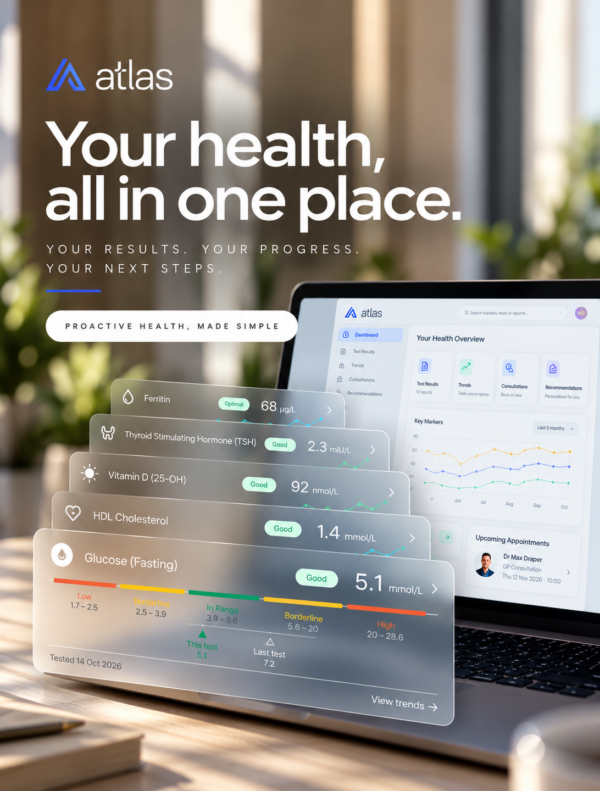
Rather than viewing each blood test as an isolated event, the portal brings your available results and relevant health information into one connected space.
You can:
- Access your current and available previous blood test reports.
- Compare biomarkers across previous investigations.
- Visualise changes and trends over time.
- Review relevant clinical documents and recommendations.
- Access GP consultations when additional interpretation or clinical guidance is needed.
Whether you’re monitoring a particular health concern, reviewing changes after treatment or simply looking to understand your health more clearly, having your results organised in one place can provide useful perspective.
Of course, the ability to see a trend does not mean every change requires action.
The value lies in understanding what those changes may mean for you, with appropriate clinical support where needed.
Frequently Asked Questions
Why have my blood test results changed since my last test?
Results can change because of natural biological variation, differences in testing conditions, medications, recent exercise, illness or changes in health.
Some differences may also reflect laboratory measurement variation.
The significance depends on the biomarker and the circumstances.
Can stress cause abnormal blood test results?
Stress can influence certain physiological systems, including cortisol regulation.
However, the effect varies between biomarkers and individuals.
An abnormal result should not automatically be attributed to stress without appropriate assessment.
Can lack of sleep affect blood test results?
Sleep restriction can affect hormonal regulation and insulin sensitivity.
However, not every blood marker will change after poor sleep, and individual results require clinical interpretation.
Can exercise affect liver blood tests?
Yes. Strenuous exercise can temporarily increase AST and sometimes ALT through their release from skeletal muscle.
Elevated liver-associated enzymes may also have other causes, so results need to be considered alongside clinical history and relevant investigations.
Is it normal for blood test results to fluctuate?
Some variation is expected. However, the amount considered normal differs between biomarkers.
A new, substantial or persistent abnormality may require further assessment even if other measurements have remained stable.
Can a blood test be normal but still show changes from my previous results?
Yes. Two results can both fall within the laboratory’s reference range while being numerically different.
Whether the difference is meaningful depends on biological variation, measurement uncertainty and clinical circumstances.
Should I repeat a blood test if my results have changed?
Not necessarily. Repeat testing depends on the degree of change, the biomarker, your symptoms and the reason for testing.
Some results require prompt clinical attention rather than waiting for a routine repeat test. A healthcare professional can advise whether another test or further investigation is appropriate.
Your Blood Tests Changed. But What Changed in Your Life?
Your results don’t exist in isolation.
Neither does your health.
A change in your blood biomarkers can reflect many different factors, from ordinary biological variation to changes in your lifestyle, medications or medical circumstances.
Some changes are expected.
Others deserve further investigation.
And sometimes, understanding the circumstances surrounding a blood test is just as important as understanding the number itself.
The aim isn’t to chase perfect results, test more frequently than necessary or interpret every fluctuation as a problem.
It’s to make informed decisions based on meaningful information.
Because understanding your health isn’t just about knowing where your results are today. It’s about understanding the bigger picture.
Your Health. All in One Place.
Access your My Atlas blood test results, explore available biomarker trends and keep your health information connected through the My Atlas Patient Portal.
Explore the My Atlas Patient Portal
Proactive health, made simple.
This article is intended for educational purposes and does not replace personalised medical advice.
Blood test results should be interpreted in conjunction with symptoms, medical history, clinical circumstances and appropriate professional guidance.
Latest Insights
Stay up to date with latest research, tips and trends in health and nutrition.