Understanding Your Adrenal Glands: Cortisol, DHEA, Aldosterone and the HPA Axis Explained
A guide to what the adrenal glands actually do, the hormones they produce, what happens when they are under sustained pressure - and what testing can and cannot tell you.
18 May 2026

Quick Facts
• The adrenal glands sit above the kidneys and produce hormones essential to survival – including cortisol, aldosterone, DHEA and adrenaline.
• Cortisol follows a daily circadian rhythm; it should peak within 30–60 minutes of waking and decline throughout the day.
• DHEA and DHEAS are the most abundant steroid hormones in the human body; they peak in the third decade of life and decline significantly with age.
• Aldosterone regulates blood pressure and electrolyte balance — its dysfunction causes hypertension and fatigue that is frequently misattributed to other causes.
• ‘Adrenal fatigue’ is not a recognised medical diagnosis; HPA axis dysregulation is the accurate clinical term – it is measurable and well-documented.
• NICE guidelines and the 2024 European Society of Endocrinology recommend a morning serum cortisol (08:00–10:00) as the initial investigation for suspected adrenal insufficiency.
The adrenal glands are small – each one weighing only around four to five grams – yet their hormonal output influences nearly every system in the body. They govern the stress response, blood pressure regulation, metabolic rate, immune function, electrolyte balance, sleep-wake cycles, and the precursor supply for sex hormone production.
When adrenal function is optimal, these systems operate in the background. When it is not; whether through frank pathology, chronic stress, or the more common subclinical HPA axis dysregulation seen in burnout and prolonged physiological load, the effects are felt across multiple domains simultaneously.
This article covers the anatomy and function of the adrenal glands, the hormones each zone produces, the clinical conditions that arise from excess or deficiency, the accurate evidence-based picture of ‘adrenal fatigue’, and what testing does and does not tell us.
Adrenal Gland Anatomy – Two Glands, Two Systems
Each adrenal gland is structurally divided into two distinct regions with different embryological origins, different regulatory systems, and different hormonal outputs: the outer cortex and the inner medulla.
The adrenal cortex accounts for approximately 80–90% of total gland volume. It is subdivided into three concentric layers – the zona glomerulosa, zona fasciculata, and zona reticularis — each producing a different class of steroid hormone. The cortex is regulated primarily by ACTH (from the pituitary) and the renin-angiotensin-aldosterone system (RAAS) for its outermost layer.¹
The adrenal medulla is the inner core. It develops from neural crest cells – the same embryological origin as the sympathetic nervous system – and produces catecholamines: adrenaline (epinephrine) and noradrenaline (norepinephrine). It is regulated directly by pre-ganglionic sympathetic nerve fibres rather than by circulating hormones, which allows for the rapid adrenaline release characteristic of the acute stress response.
Zona Glomerulosa – Aldosterone and Fluid Balance
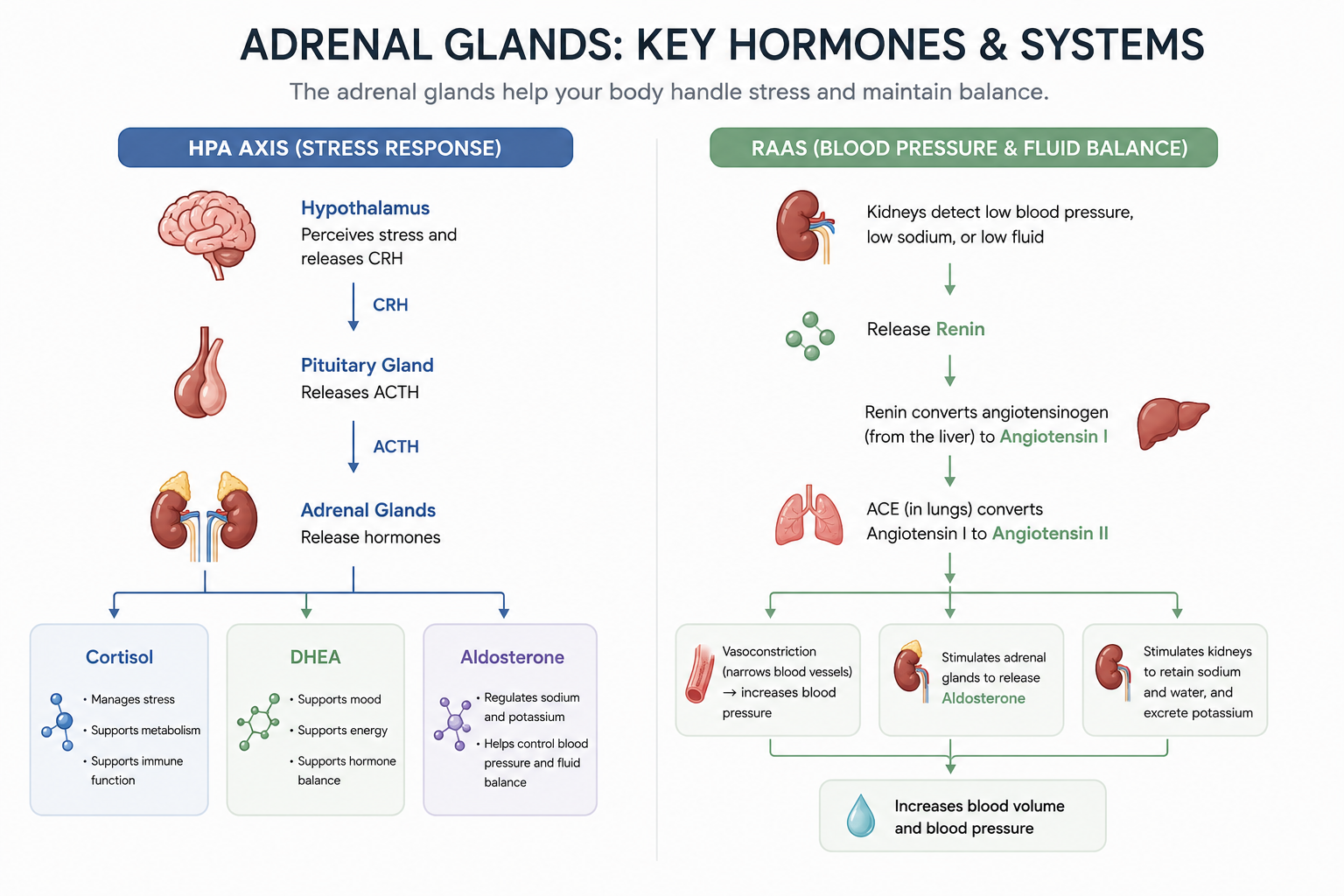
The outermost cortical layer, the zona glomerulosa, produces mineralocorticoids — primarily aldosterone. Aldosterone is the principal regulator of fluid and electrolyte balance in the body. It acts on the distal tubules and collecting ducts of the kidney, promoting sodium reabsorption and potassium excretion, which in turn drives water retention and blood pressure maintenance.
Aldosterone secretion is regulated primarily by the renin-angiotensin-aldosterone system (RAAS) – a cascade triggered by low blood pressure, low sodium, or low blood volume – and by elevated serum potassium. It is largely independent of ACTH, which is why aldosterone production is usually preserved in secondary adrenal insufficiency but lost in primary adrenal insufficiency (Addison’s disease).²
When Aldosterone Goes Wrong
Primary aldosteronism – excess aldosterone production from one or both adrenal glands – is now recognised as the most common cause of secondary hypertension, affecting an estimated 5–10% of people with high blood pressure and up to 20% of those with treatment-resistant hypertension.³ It often presents without the classical features of low potassium, meaning it goes undetected for years while hypertension is managed symptomatically.
In Addison’s disease, aldosterone deficiency causes sodium wasting, potassium retention, low blood pressure, and dehydration.
The British Journal of General Practice notes that a morning serum cortisol below 100 nmol/L requires rapid investigation, while levels between 100 and 500 nmol/L are indeterminate and warrant a short synacthen test.⁴
Zona Fasciculata – Cortisol and the Stress Response
The middle and largest cortical zone, the zona fasciculata, produces glucocorticoids – the most important of which is cortisol.
Cortisol is the primary mediator of the body’s physiological response to stress, but its role extends far beyond acute stress management.
Cortisol is essential for survival. It mobilises glucose and fatty acids for energy, modulates immune and inflammatory responses, supports cardiovascular function, regulates blood pressure (partly through sensitising blood vessels to catecholamines), and critically, governs the circadian rhythm of alertness and sleep readiness.
The Cortisol Awakening Response and Diurnal Rhythm
In a healthy HPA axis, cortisol follows a precise circadian arc.
Levels are lowest during the first hours of sleep and begin rising in the early morning hours driven by the circadian clock.
Within 30–60 minutes of waking, cortisol surges by 50–100% above baseline – a phenomenon called the Cortisol Awakening Response (CAR).
This morning peak primes the immune system, activates memory consolidation, and prepares metabolic systems for the demands of the day. Levels then decline progressively throughout the afternoon and evening, reaching their nadir in the late evening to allow melatonin to rise and sleep to begin.⁵
Research published in the European Journal of Cardiovascular Medicine demonstrated that individuals with chronic stress showed significantly flattened diurnal cortisol slopes compared to controls — with markedly lower morning cortisol (8.2 ± 1.1 ng/mL vs 13.6 ± 1.3 ng/mL) alongside elevated inflammatory markers including IL-6, TNF-α, and CRP.⁶
The disruption of this rhythm is not merely a downstream effect of stress, it drives further physiological dysfunction through immune dysregulation, metabolic impairment, and sleep disruption.
The Cortisol-Cortisone Equilibrium
Most circulating cortisol is inactive, bound to cortisol-binding globulin (CBG). Free cortisol is the biologically active fraction.
Additionally, cortisol exists in dynamic equilibrium with cortisone, its inactive metabolite, through the 11β-hydroxysteroid dehydrogenase (11β-HSD) enzyme system: 11β-HSD1 converts cortisone back to active cortisol (predominantly in liver and adipose tissue); 11β-HSD2 inactivates cortisol to cortisone (predominantly in the kidney, protecting mineralocorticoid receptors from cortisol’s glucocorticoid effects).
Disruptions to this system – driven by obesity, chronic stress, and metabolic dysfunction – affect local cortisol availability independently of what serum measurements show.
Zona Reticularis – DHEA, DHEA-S and Adrenal Androgens
The innermost cortical zone, the zona reticularis, produces adrenal androgens – primarily dehydroepiandrosterone (DHEA) and its sulphated form, DHEA sulphate (DHEA-S).
DHEA-S is the most abundant circulating steroid hormone in the human body and functions as a precursor – a hormonal reservoir from which active sex steroids (testosterone and oestrogen) are synthesised in peripheral tissues through a process called intracrinology.⁷
DHEA and DHEAS exert direct neurosteroid effects independently of their conversion to sex steroids. They modulate GABA-A, NMDA, and sigma-1 receptors in the brain, contributing to neuroprotection, cognitive function, mood regulation, and synaptic plasticity. Low DHEAS has been associated with depression, reduced cognitive performance, and increased all-cause frailty and mortality in older adults.⁸
Adrenarche and Adrenopause
DHEA and DHEAS follow a distinct life course that is unique to humans and great apes. Production rises sharply in childhood (adrenarche), peaks in the third decade of life, and then undergoes a progressive, age-related decline – a phenomenon termed adrenopause. By the age of 70–80, DHEAS levels are typically 10–20% of their peak values. This decline is associated with near-complete loss of the zona reticularis.⁹
The clinical significance of this decline is still being established. Epidemiological studies have consistently associated low DHEAS in older age with increased frailty, impaired immune function, and elevated mortality risk.
However, clinical trials of oral DHEA supplementation have produced mixed results, benefits in some contexts (particularly genitourinary symptoms in post-menopausal women) but no consistent improvement in body composition, muscle strength, or metabolic markers in the general population.¹⁰
The Endocrine Society does not currently recommend routine DHEA supplementation in ageing individuals outside of adrenal insufficiency.
DHEAS as a Marker of Adrenal Reserve
In clinical practice, DHEAS has a specific diagnostic utility: as a marker of adrenal androgen production. In adrenal insufficiency, DHEAS falls in tandem with cortisol, often earlier.
Research has demonstrated that a normal age- and sex-adjusted DHEAS level predicts intact HPA axis function with a sensitivity of 87.1% and specificity of 86.7%.¹¹
Conversely, low DHEAS in the presence of symptoms – fatigue, low libido, reduced stress resilience, mood disturbance – is a signal that adrenal androgen output is impaired, even when cortisol itself remains borderline.
Adrenal Medulla – Adrenaline and the Acute Stress Response
The adrenal medulla produces catecholamines – adrenaline (epinephrine) accounting for approximately 80% of output, with noradrenaline (norepinephrine) making up the remainder. Unlike the cortex, the medulla is regulated directly by sympathetic nerve input and responds within seconds to acute threat, physical exertion, or perceived danger.
Adrenaline drives the classical ‘fight or flight’ response: rapid increases in heart rate and cardiac output, vasoconstriction in non-essential vascular beds, broncho-dilation, elevated blood glucose, and heightened mental alertness.
This response is essential for survival and appropriate for short-term challenges.
The medulla is rarely the primary site of clinical dysfunction in everyday fatigue or stress-related presentations. However, phaeochromocytoma – a rare tumour of the adrenal medulla or related chromaffin tissue – causes episodic hypertension, palpitations, sweating, and headache through unregulated catecholamine excess.
It is uncommon but important to consider in the differential diagnosis of episodic cardiovascular symptoms.
The HPA Axis Under Chronic Stress – What Actually Happens
The HPA axis is designed for acute activation followed by recovery.
The cascade:
Hypothalamus releases CRH → pituitary releases ACTH → adrenal glands produce cortisol → cortisol feeds back to suppress CRH and ACTH – functions effectively when stress is time-limited.
Under chronic or repeated stress, this system adapts, and the adaptations are not benign.
Research modelling HPA axis dynamics has shown that prolonged stress causes structural changes in the axis itself: the functional mass of both pituitary corticotrophs and adrenal cortical cells enlarges under sustained activation.
Recovery of these functional masses takes weeks after stress is removed — meaning ACTH responses remain blunted for weeks after cortisol has normalised. This explains why people emerging from prolonged stress periods often feel worse, not better, in the immediate aftermath.¹²
A systematic review in the American Journal of Medicine (2025) described HPA axis dysfunction in two recognisable phases: an initial phase characterised by heightened cortisol output, anxiety, sleep disruption, and elevated blood pressure; followed by a hypoactive phase — blunted cortisol, persistent fatigue, poor stress tolerance, low mood, and reduced resilience – as the system down-regulates in response to sustained demand.¹³
A 2025 systematic review in MDPI confirmed that across the burnout literature, blunted diurnal cortisol variation and altered HPA axis responsiveness are consistent findings — reinforcing that burnout is not simply psychological but represents a measurable neuroendocrine state.¹⁴
‘Adrenal Fatigue’ – The Accurate Clinical Picture
‘Adrenal fatigue’ is not a recognised medical diagnosis and does not appear in NICE, NHS, or international endocrinology guidelines. The adrenal glands do not become ‘exhausted’ in the way the term implies. This is clinically important to state clearly.
What is well-documented is HPA axis dysregulation – a state in which the rhythm, amplitude, and responsiveness of cortisol secretion is disrupted, producing symptoms of fatigue, poor sleep, reduced stress tolerance, and cognitive impairment without frank adrenal insufficiency.
This is a real, measurable physiological state. It is distinct from Addison’s disease. It does not require the adrenal glands to be failing. And it is not captured by a single morning cortisol measurement.
The distinction matters because it determines what investigation is appropriate and what interventions are likely to help. Lifestyle, recovery, sleep, and stress management are the primary interventions for HPA dysregulation.
Glucocorticoid replacement – the treatment for adrenal insufficiency – is not appropriate and carries significant risk if prescribed without confirming true insufficiency.
Clinical Conditions of the Adrenal Glands
Understanding the spectrum of adrenal pathology – from frank insufficiency to subtle subclinical dysfunction – helps contextualise where testing is most valuable.
| Condition | Primary Abnormality | Key Symptoms | Key Diagnostic Test |
| Addison’s disease | Primary adrenal insufficiency – cortisol and aldosterone deficiency | Fatigue, weight loss, hyperpigmentation, low BP, salt craving, nausea | Morning cortisol; short synacthen test; ACTH |
| Secondary adrenal insufficiency | ACTH deficiency from pituitary dysfunction | Fatigue, low cortisol – but aldosterone usually preserved | Morning cortisol; ACTH; pituitary MRI |
| Primary aldosteronism | Excess aldosterone from adrenal gland | Hypertension (often treatment-resistant), fatigue, low potassium (often absent) | Aldosterone:renin ratio; CT adrenal; adrenal vein sampling |
| Cushing’s syndrome | Cortisol excess (various causes) | Central weight gain, thin skin, easy bruising, hypertension, diabetes, low mood | 24hr urinary free cortisol; late-night salivary cortisol; dexamethasone suppression test |
| HPA axis dysregulation | Disrupted cortisol rhythm without frank insufficiency | Fatigue, poor sleep, brain fog, low resilience, ‘wired but tired’ | Morning cortisol; DHEAS; diurnal cortisol profile |
| Phaeochromocytoma | Catecholamine excess from adrenal medulla tumour | Episodic hypertension, palpitations, sweating, headache | 24hr urinary metanephrines; plasma metanephrines |
What Adrenal Testing Can and Cannot Tell You
The most important principle in adrenal testing is that timing and context matter as much as the result itself.
Cortisol follows a pronounced circadian rhythm – a value taken at 2pm is not comparable to one taken at 8am. A single morning cortisol measurement is the recommended initial investigation for suspected adrenal insufficiency, but it has significant limitations in identifying the subtler patterns of HPA dysregulation.
Morning Serum Cortisol
The 08:00–09:00 serum cortisol is the standard first-line test for suspected adrenal insufficiency. The British Journal of General Practice provides clear clinical thresholds: a result above 500 nmol/L makes adrenal insufficiency very unlikely; below 100 nmol/L is definitively abnormal and requires urgent investigation; values between these thresholds are indeterminate and require a short synacthen (ACTH stimulation) test for clarification.⁴
For assessing HPA axis function in the context of chronic stress or fatigue (rather than confirming or excluding frank insufficiency), a morning cortisol at the lower end of the reference range — combined with a low DHEAS and clinical symptoms — provides a meaningful signal even without meeting the threshold for adrenal insufficiency.
DHEA-S
DHEAS is a more stable marker than cortisol — it has minimal diurnal variation and a half-life of several hours, making it less sensitive to the timing of the blood draw. It provides a useful index of zona reticularis function and overall adrenal androgen output. Low DHEAS alongside a low-normal morning cortisol, in someone with the appropriate symptom profile, strengthens the case for meaningful HPA axis impairment.
What Testing Cannot Confirm
A single cortisol result, however normal, cannot confirm that the HPA axis is functioning optimally.
It cannot characterise the diurnal rhythm, quantify the CAR, assess reactivity to stress, or evaluate the cortisol:DHEAS ratio as a marker of the cortisol-to-androgen balance that often shifts unfavourably under chronic stress.
More comprehensive assessment requires a diurnal cortisol profile (multiple measurements across the day) or a urinary/salivary cortisol protocol (DUTCH Complete) – tools used in specialist and research settings rather than standard primary care.
It is also essential to interpret results in context. A morning cortisol of 280 nmol/L in someone who is chronically unwell, exhausted, and symptomatic carries different clinical weight than the same value in someone who feels entirely well.
Laboratory reference ranges define population statistics; they do not define the optimal range for an individual.
Frequently Asked Questions
What is the difference between adrenal fatigue and adrenal insufficiency?
Adrenal insufficiency (including Addison’s disease) is a recognised medical condition in which the adrenal glands fail to produce sufficient cortisol, and in primary insufficiency, aldosterone.
It is diagnosed by specific blood tests and requires medical treatment including hormone replacement. ‘Adrenal fatigue’ is not a recognised diagnosis – the term describes a pattern of symptoms (fatigue, poor stress tolerance, disrupted sleep, brain fog) that are real and often reflect HPA axis dysregulation, but do not represent adrenal gland failure. The distinction matters for treatment.
What blood tests assess adrenal function?
A morning serum cortisol (08:00–09:00) is the standard first-line test. DHEAS provides a measure of adrenal androgen output and is more stable across the day. If adrenal insufficiency is suspected and morning cortisol is borderline, a short synacthen (ACTH stimulation) test is required. Plasma ACTH can help distinguish primary from secondary insufficiency.
For aldosterone-related hypertension, an aldosterone:renin ratio is the first-line investigation.
Can cortisol levels be normal and still have adrenal problems?
Yes. A normal morning cortisol does not rule out a disrupted diurnal rhythm, a blunted cortisol awakening response, or impaired adrenal androgen production. HPA axis dysregulation – the physiological consequence of sustained chronic stress — can be present with a cortisol that falls within the population reference range.
Clinical assessment must incorporate symptoms, DHEAS, context, and ideally a fuller diurnal picture.
Why does DHEAS decline with age?
DHEAS production by the zona reticularis begins declining from the third decade of life — a process called adrenopause. By the age of 70–80, DHEAS is typically 10–20% of peak levels. This reflects the progressive atrophy of the zona reticularis and is unique to humans and great apes. The clinical consequences are an area of active research but include reduced sex steroid precursor availability, diminished neuroprotective and anti-inflammatory effects, and associations with frailty and all-cause mortality in older populations.
What are the symptoms of high cortisol?
Chronic cortisol excess, as seen in Cushing’s syndrome produces a characteristic constellation: central adiposity with relative limb sparing, a rounded face, fat deposition at the back of the neck, thin and easily bruised skin, purple striae, proximal muscle weakness, hypertension, glucose intolerance, low mood, and impaired immune function.
Mild or cyclical cortisol elevation from chronic stress produces a more diffuse picture including weight gain, sleep disruption, anxiety, fatigue, and metabolic changes.
Is a cortisol blood test enough to assess the full picture?
No. A single morning cortisol is the right starting point for suspected adrenal insufficiency, but it does not characterise the diurnal rhythm, the cortisol awakening response, adrenal androgen output, or the dynamic response to stress.
A comprehensive adrenal assessment includes morning cortisol, DHEAS, and clinical context as a minimum with a short synacthen test when insufficiency is suspected and borderline results are found.
Final Thoughts
The adrenal glands are among the most consequential endocrine structures in the body. They do not simply produce adrenaline in moments of danger – they govern the daily rhythm of energy and alertness, regulate blood pressure and fluid balance, provide the precursor supply for sex hormone synthesis, and modulate immune function in ways that affect long-term disease risk.
Understanding adrenal function means understanding the full hormonal output of each zone – cortisol, aldosterone, DHEA – and the regulatory systems that govern them.
It also means being accurate about what testing can and cannot tell us: a normal morning cortisol is reassuring but not definitive; a low DHEAS alongside fatigue and reduced resilience is clinically meaningful even without meeting the threshold for adrenal insufficiency.
The most common clinical presentation related to adrenal function is not Addison’s disease or Cushing’s syndrome – it is the subtler disruption of HPA axis rhythm and DHEAS decline that accompanies chronic stress, burnout, ageing, and sustained physiological load. This is real, measurable, and addressable.
But it requires the right questions, the right tests, and results interpreted in the context of how the person actually feels.
Small glands. Enormous consequences. Understanding them properly is worth the effort.
REFERENCES
1. Physiology, Adrenal Gland. StatPearls — NCBI Bookshelf. NIH. Updated 2023.
2. Adrenal Insufficiency — Endotext, NCBI Bookshelf. NIH. Updated 2026.
3. Long KC, Azizan EA. The adrenal gland and primary aldosteronism. Frontiers in Endocrinology. 2026.
4. Bornstein SR et al. Addison’s disease: identification and management in primary care. BJGP. 2015;65(638):488.
5. TeachMePhysiology. Hypothalamic-Pituitary-Adrenal (HPA) Axis. Updated 2025.
6. Assessment of HPA Axis Function in Chronic Stress: Correlation with Cortisol Rhythms and Immune Markers. European Journal of Cardiovascular Medicine. 2025.
7. Iida A et al. Anti-aging effects of DHEA and DHEAS: mechanisms of action. PMC. 2025.
8. The Sex Hormone Precursors DHEA and DHEAS: Molecular Mechanisms and Actions. NCBI PMC. 2025.
9. Parker CR. Changes in adrenocortical function with aging. PubMed.
10. Adrenal Androgens and Aging. Endotext — NCBI Bookshelf. NIH. Updated 2023.
11. Glucocorticoid Withdrawal — Diagnosing Adrenal Insufficiency in Clinical Practice. MDPI Diagnostics. 2021.
12. Karin M, Alon U. A new model for the HPA axis explains dysregulation of stress hormones. PMC. 2020.
13. An Integrative Approach to HPA Axis Dysfunction: From Recognition to Recovery. American Journal of Medicine. 2025.
14. Burnout and HPA Axis Dysregulation: A Systematic Review. MDPI. 2025.
Latest Insights
Stay up to date with latest research, tips and trends in health and nutrition.